


This blog looks at what to consider before saying “yes” to any leadership coaching certification.
If you’re thinking about becoming a leadership coach, chances are you’ve already spent time researching your options and discovered just how overwhelming the process can be.
A quick Google search for “leadership coach certification” brings up hundreds of programs, each promising to be the best, fastest, or most accredited path to success.
Some programs promote flashy bonuses instead of focusing on the actual coaching curriculum. Others might bury the details in marketing speak, making it difficult to find information about pricing, structure, or faculty qualifications. More than a few still promote outdated terminology (like ACSTH or ACTP) even though the ICF replaced those pathways in 2023 with a clearer Level 1, 2, and 3 framework.
So how do you choose the right training?
In this post, I’ll walk you through what really matters when choosing a leadership coach training program – especially if you’re planning to pursue ICF credentials (like the ACC, PCC, or MCC) and want to build a coaching practice rooted in ethics, professionalism, and long-term success.
While there are many coach training pathways out there, the International Coaching Federation (ICF) remains the most widely recognized credentialing body for leadership coaches worldwide.
Let’s unpack the core questions you should ask before enrolling, and what separates a high-integrity training experience from the rest.

Why Your Choice of Leadership Coach Training Matters
Becoming a leadership coach is a meaningful and rewarding path, but without the right training, it’s also one that’s easily misunderstood.
Yet when it’s done properly and ethically, coaching is one of the most powerful professional development tools we have. It can transform lives, teams, and entire organizations. But that impact starts with high-quality training.
If you’re truly committed to:
- Earning your ICF credential
- Being taken seriously as a leadership coach
- Building trust with clients or with the teams you lead
- Using coaching as a core leadership style
…then choosing the right coach training program is your first essential step.
But here’s an important caveat: Not all programs are ICF accredited. And not all ICF-accredited programs are designed for leadership coaching.
That’s why it’s important to understand the ICF’s current training structure and to know the difference between generalist coach training and programs built specifically for leadership, executive, and organizational contexts.
If you’re still getting up to speed on what the ICF credentialing process looks like, you may want to start with this post: How to Become a Certified Coach: Understanding ICF Credentials and Certification Programs. Then, for a closer look at what it takes to become a leadership coach, take a look at Leadership Coach Certification: Everything You Need To Know About Becoming a Leadership Coach.
Ultimately, the quality of your training will shape how you show up as a coach. It affects the trust you build, the outcomes you facilitate, and whether your coaching feels professional and trustworthy – or simply like well-meaning advice.

The ICF Has Changed. Make Sure the Program Has, Too.
If you’ve started researching coach training programs, you might have seen terms like ACSTH or ACTP floating around. These were part of the ICF’s previous accreditation system, but as of 2023, they’re no longer used for new programs.
Today, the International Coaching Federation (ICF) accredits training under a clearer three-level system:
- Level 1: Designed for ACC applicants (60+ training hours)
- Level 2: Primarily for PCC applicants (125+ training hours)
- Level 3: For MCC applicants (200+ training hours)
Programs previously accredited under ACTP or ACSTH are now considered legacy programs. If you were enrolled in one before the change, your hours still count. But if you’re choosing a program today, make sure it’s approved under the current Level 1 or Level 2 framework.
There’s also the Portfolio Path, intended for coaches who’ve completed non-accredited or mixed-source training. While valid, this route requires significantly more documentation and recorded coaching sessions.
Bottom line: If you’re pursuing an ACC or PCC credential, it’s much more efficient to choose a program that is clearly marked as ICF-accredited under Level 1 or Level 2.
Wait. Who Certifies What?
If you’re still sorting out the difference among terms like coach training, certification, and credentials, you’re not alone. These terms get used interchangeably, but they actually mean very different things. Here’s a quick table to help you make sense of it:
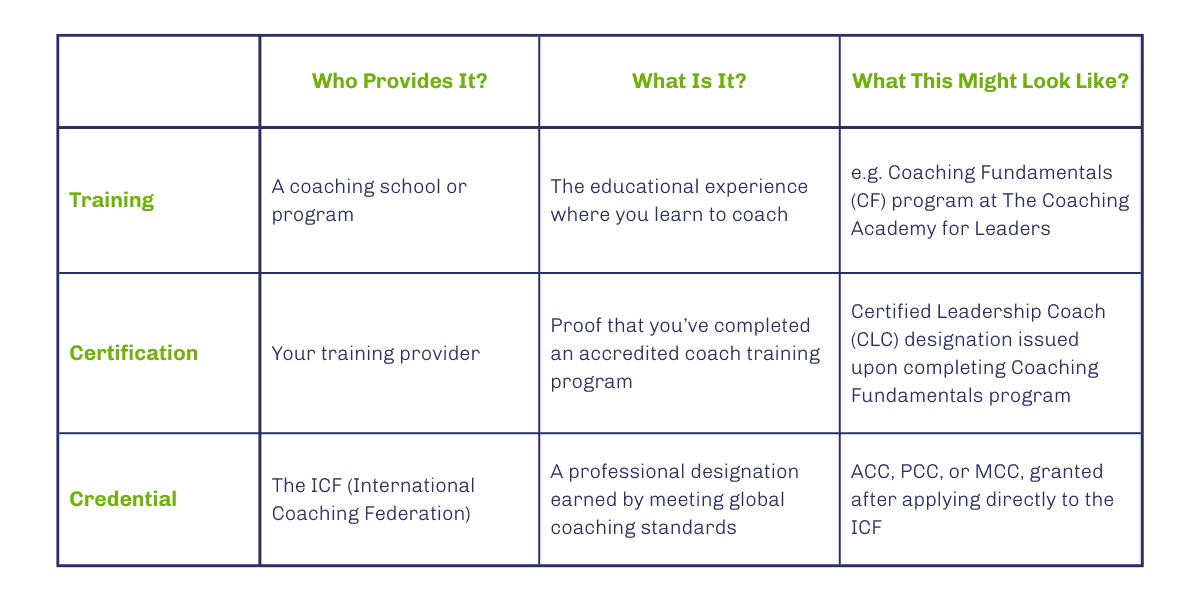
A truly professional coach training program – like Coaching Fundamentals – should certify your training and prepare you to meet ICF credentialing standards. But only the ICF can award you the ACC, PCC, or MCC designation.

6 Questions to Ask Before You Enroll in a Leadership Coaching Program
Now that you know what ICF-accredited training means, let’s talk about how to evaluate the programs themselves. Here are six key questions to ask when deciding which one is right for you.
1. Is the program ICF-accredited at Level 1 or Level 2?
If your goal is to earn an ICF credential like the ACC or PCC, the very first thing to check is that the program is currently accredited by the ICF under the updated system. If you’re just starting out, look for a program that’s clearly marked as ICF Level 1 or Level 2 accredited.
You can use the ICF’s Education Search Service (ESS), a free directory to verify if a program you’re considering is truly ICF-accredited.
It’s important to understand that the International Coaching Federation (ICF) does not offer coach training itself. Instead, the ICF accredits training programs that meet their high professional standards. If you want to pursue an ICF credential, the first step is to complete an ICF-accredited program, but earning the credential also requires additional components, including coaching hours, mentor coaching, and successfully completing the ICF exam.
If you’re looking for a program that’s already aligned with these standards, our Coaching Fundamentals course is ICF Level 1-accredited and designed specifically for leadership and organizational coaching contexts.

2. Does the curriculum teach coaching (or consulting in disguise)?
Not everything labeled “coach training” is actually about coaching. Some programs lean heavily on frameworks that sound helpful but are rooted in consulting or advising. You’ll often hear language like:
- “Follow our tried and true process to get unstuck.”
- “Teach your clients the steps to succeed.”
- “Provide your clients with proven strategies to fix their problems.”
These approaches aren’t wrong, but they’re not coaching. Professional coaching, especially as defined by the ICF, is about creating a thinking partnership. It’s not about telling, teaching, or solving. A well-trained coach learns how to ask powerful questions, listen deeply, and hold space for the client’s own thinking and insights to emerge.
That’s the difference between facilitating transformation and giving advice. A truly ICF-aligned training program will center its curriculum around the Core Competencies of Coaching, not pre-scripted methods, formulas, or life-planning templates.
If you’d like a refresher, here’s a breakdown of the ICF Core Competencies and how we teach them in Coaching Fundamentals.

3. Will I be learning how to coach leaders specifically?
There’s more to leadership and executive coaching than helping individuals hit personal goals. It requires coaching skills to support clients to uncover a deeper understanding or new perspective of systems, relationships, and organizational complexity.
When you coach a leader, you’re not just supporting one person. They are also influencing their team, their culture, and often, their organization’s strategy. That’s why leadership coaching demands a strong foundation in areas like emotional intelligence, organizational dynamics, and power structures.
Some generalist coach training programs are excellent. But if your goal is to coach leaders, managers, or high-performing professionals, make sure the curriculum actually prepares you for those conversations. You should be prepared to support clients as they explore how to:
- Navigate team and culture challenges
- Understand leadership mindsets and responsibilities
- Support people who are under pressure to perform, influence, and drive change
- Work with executives, teams, and leaders in organizational contexts, rather than just individuals in life transitions
At The Coaching Academy for Leaders, we teach coaching through the lens of real-world leadership. Our students learn to coach within the context of organizational life, not just one-on-one goal setting.

4. How is the learning delivered?
When you’re evaluating coach training programs, the format matters as much as the content. Some important questions to ask are:
- Is the learning live, recorded, or a blend of both?
- Will you be part of a cohort, or learning solo?
- Are there opportunities for real-time coaching practice?
- Do you receive feedback and mentorship from experienced faculty?
The best coach training happens in a community – where you can observe, practice, reflect, and grow alongside others. More than the theory, learning to coach means you get to build confidence through real coaching conversations.
The learning experience in Coaching Fundamentals is deliberately designed for active engagement. The program includes:
- Weekly live training sessions
- Small group practicums with peer coaching and structured feedback
- 1:1 faculty coaching to deepen your development
- Mastermind-style learning cohorts
- The Lumina Spark psychometric assessment to enhance self-awareness and communication style
It’s a supportive, interactive experience, not a passive one.

5. Is Mentor Coaching included or available?
To apply for an ICF credential, you’ll need to complete 10 hours of ICF-compliant Mentor Coaching. This requirement is often misunderstood, but it’s a vital part of the process.
Mentor Coaching isn’t just a formality. It’s your opportunity to refine your skills, receive structured feedback, and deepen your alignment with the ICF Core Competencies. It also gives you practice presenting recorded coaching sessions for review – something you’ll need when you apply for your ACC, PCC, and MCC.
Some training programs include Mentor Coaching in their tuition. Others offer it as a separate program. Either way, make sure the school you choose offers a Mentor Coaching path that aligns with ICF credentialing standards so you’re fully supported when you’re ready to apply.
We offer Group Mentor Coaching as a companion to Coaching Fundamentals. Many students choose to bundle both, giving them a seamless and supported path from training to credentialing.

6. What happens after the course ends?
Great coach training doesn’t end with a certificate; it should support your growth long after the classroom sessions are over.
As you evaluate programs, consider the follow-through:
- Will you be part of a supportive alumni network?
- Is there a coach community to stay connected and inspired?
- Will you have access to resources, referrals, or ongoing development?
The transition from training to practice is where many new coaches feel the most uncertain. That’s why it matters to choose a program that offers structure, connection, and real-world opportunities beyond the curriculum.
Graduates of Coaching Fundamentals are invited to join our private alumni program, The Elevation Network – a professional space to exchange ideas, stay connected, and continue learning.
You’ll also have the option to join our Coach Bench directory, which connects qualified alumni with opportunities for paid coaching engagements. Getting certified marks a milestone in your coaching career, but it’s just as important to stay supported as you grow.

In Summary: A Great Leadership Coach Training Program Will…
✅ Be ICF Level 1, Level 2, or Level 3 accredited
✅ Teach the core tenets of coaching: not advice, tips, or formulas
✅ Prepare you for leadership and organizational contexts
✅ Include live practice, feedback, and mentor support
✅ Align with ICF ethics and coaching competencies
✅ Offer a learning community
✅ Support your growth during training and beyond
What Comes Next
Choosing a coach training program is a meaningful decision. If you’re looking for a path that’s rooted in integrity, aligned with ICF standards, and designed for people who want to coach leaders, I invite you to explore Coaching Fundamentals.
This six-month, ICF Level 1-accredited program is designed to give you a strong foundation in professional coaching, grounded in real practice, small-group learning, and personalized faculty support.
Learn more about Coaching Fundamentals and join the next cohort.
You’ll learn in a community. You’ll be supported by experienced faculty. And you’ll come away with the confidence and skill to coach with purpose.
Whatever path you choose, I hope this article helped you move forward with a little more clarity and a lot more confidence. Here’s to better leaders, better choices, and better conversations!
If you’re curious about the unique power of coaching as a leadership approach, you might enjoy this companion piece: Leadership Coaching Programs: How To Get The 3-Legged Stool Of Success Working For You. And if you’re ready to compare your options side by side, take a look at Top 12 Leadership Coach Certification Programs Compared [2025 Edition]

0 Comments